
Retail Refrigeration Solutions for Modern Businesses | Shop Solutions Midlands

The role of retail refrigeration is quiet yet powerful in the modern retail space. Supermarkets, grocery stores, cafes, and convenience stores depend on it for keeping their products fresh, safe, and visually appealing. The use of reliable refrigeration is of utmost importance to businesses in concerns related to food quality, customer satisfaction, and compliance standards. Hence, the selection of proper retail refrigeration solutions has become more crucial than ever.
This guide walks you through what retail refrigeration is, how it works in real-world settings, what types are commonly used, and what businesses should consider before investing in it. From small convenience stores to a large supermarket chain, knowledge of these systems will enable you to make more informed and cost-effective decisions.
What Is Retail Refrigeration and Why Does It Matter?
This term refers to the cooling systems developed for commercial premises, where products are displayed and stored under controlled temperature conditions. These are heavy-duty systems that are constantly opened by customers.
That keeps food and drinks fresh while making them easy for customers to see and grab. But it’s not just about cooling. It also supports branding, lifts product presentation, and helps cut waste from spoilage.
The aesthetic of refrigeration units attracts more buyers to customers. In today’s challenging retail environment, the look is as important as the functionality.
How Does Retail Refrigeration Work in Commercial Spaces?
Retail refrigeration systems work by circulating refrigerant through a cycle of compression, condensation, expansion, and evaporation. This is the same basic cycle that a refrigerator uses to remove heat from the interior and release it outside, thereby maintaining a stable cold environment.
In retail environments, the systems are assumed to handle relatively frequent door openings and constant product turnover. More advanced models come with temperature monitoring systems, energy-saving features, and smart controls.
Good airflow design is very important. It helps to distribute a uniform temperature at every shelf space and eliminates warm spots that could lead to product damage.
What Are the Main Types of Retail Refrigeration Systems?
There are several types of retail refrigerators which have been created for different uses. Your store layout, product selection, and customer traffic will determine the right type of unit for your business.
- Display Refrigerators
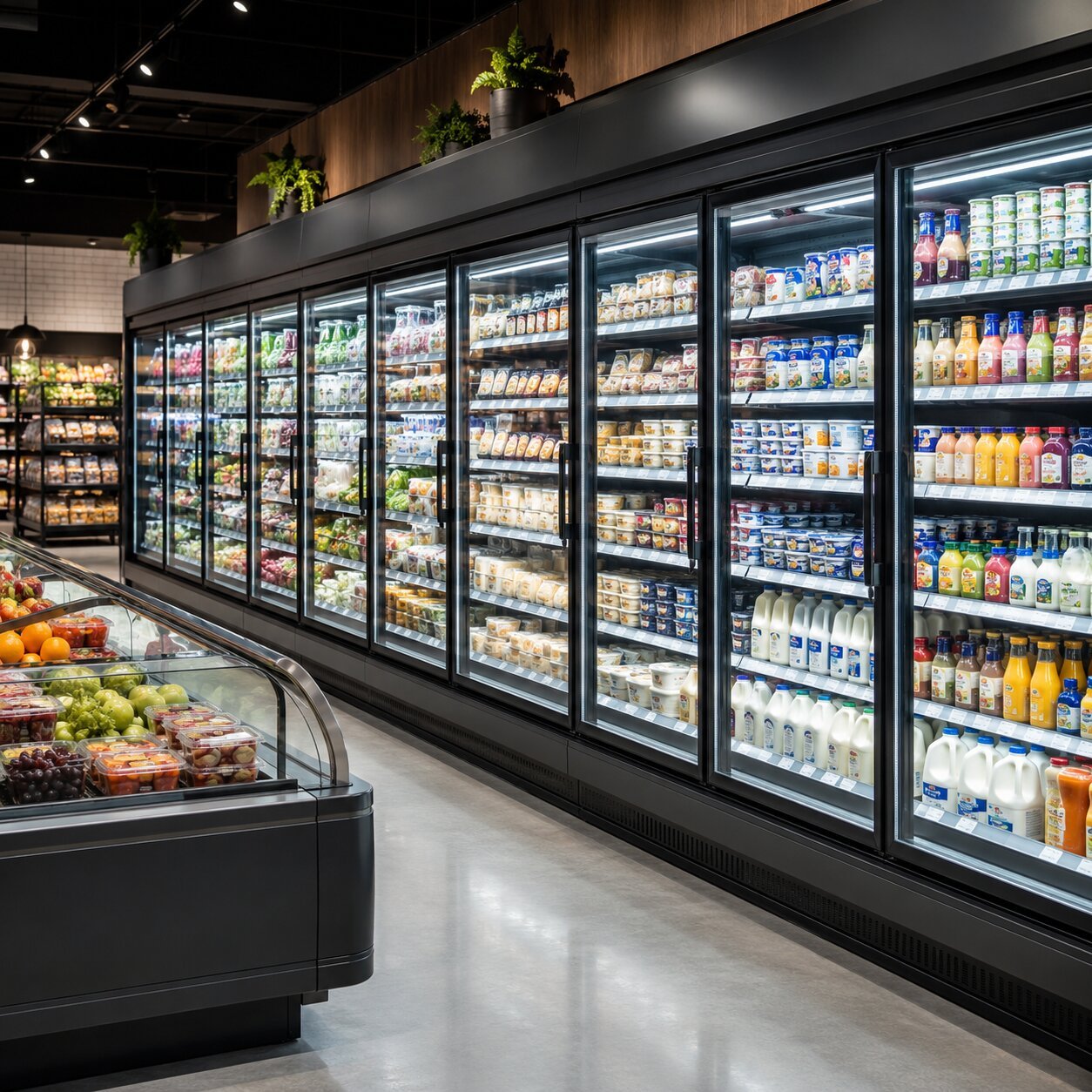
These are common in grocery stores and convenience stores. They feature glass doors or open fronts to give customers easy access to chilled items such as drinks, dairy and ready-to-eat meals.
- Multideck Chillers
Multideck chillers are open-front refrigeration units that can be easily accessed and have excellent visibility. They are commonly used for fresh produce, prepared foods, or beverages.
- Island Freezers
Island freezers are often found in the center of shops, and are a great choice for any store that sells frozen foods and bulk merchandise.
- Walk-In Cold Rooms
For larger businesses, walk-in cold rooms provide bulk storage for perishable goods. These are needed in supermarkets, hotels, and distribution centers.
- Under-Counter Refrigeration Units
These small systems are perfect for bars, cafés, or smaller retail counters where space is limited.
Why Is Energy Efficiency Important in Retail Refrigeration?
Energy efficiency has become a must rather than an option. The retail refrigeration systems run for all 24 hours, and therefore, they consume quite a significant amount of electricity.
The modern energy-efficient units use advanced compressors, LED lighting, and improved insulation to cut down on power consumption. This, in turn, reduces not only the operating costs but also the environmental impact.
For companies, an investment in energy-efficient systems means good savings in the long term and a better sustainability performance. Even the tiniest improvements in efficiency can, over time, lead to substantial cost reductions.
What Factors Should You Consider Before Buying Retail Refrigeration Equipment?
Before investing in refrigeration systems, businesses should carefully evaluate several important factors:
- Store size and layout
- Type of products being stored
- Customer traffic flow
- Temperature requirements
- Energy consumption levels
- Maintenance and servicing needs
It’s also important to consider durability. Retail environments are busy, and equipment must withstand constant use without frequent breakdowns.
Another key factor is visibility. Products should be displayed in a way that attracts attention while maintaining proper cooling performance.
How Does Retail Refrigeration Impact Customer Experience?
Retail refrigeration has a direct impact on customer interaction with products. Clear glass displays, well-lit shelving, and an organized layout help make a purchase easier for the shopper to find what they are looking for. When products are stored at the correct temperature and are presented neatly, customers feel assured of freshness and quality. This, in turn, leads to good purchase decisions and increased sales.
Poorly maintained refrigeration can quickly hurt a company’s brand. If the glass is foggy, the cooling is uneven, or the units are broken, customers will not want to buy- and that’s a bad thing.
What Are Common Challenges in Retail Refrigeration Systems?
Even the best systems face challenges over time. Some of the most common issues include:
- Temperature fluctuations
- Frost build-up
- High energy usage
- Equipment wear and tear
- Poor maintenance schedules
Regular servicing and proper installation can reduce these issues significantly. Businesses should also train staff to monitor temperature levels and report problems early.
How Can Businesses Maintain Retail Refrigeration Efficiently?
Maintenance is what will keep it running well for the long term. You can do some basic things like cleaning the condenser coils, checking the door seals, and making sure you have the right temperature setting.
Regular professional service also will guarantee you that the system works at maximum efficiency. Most of the time, preventive maintenance is much cheaper than having to do repairs because of an emergency.
Keeping refrigeration units clean and organized also improves airflow and reduces energy strain.
Why Do Businesses Rely on Professional Retail Refrigeration Solutions?
Professional refrigeration solutions deliver on three tenets: reliability, efficiency, and performance over the long run. That’s why businesses want expert providers to take care of installation, system design, and after-sales support.
For example, a trusted provider like Shop Solutions Midlands helps retailers select the most appropriate refrigeration system for their space, budget, and product requirements. This would certainly minimize future operational issues.
Final Thoughts
Refrigeration in the retail sector represents more than the simple fact of having a cooling system; it is an essential element in the success of modern commerce. It participates from the quality of the products stored to the experience of the client, and helps in the daily functioning.
Knowing the different kinds, advantages, and upkeep requirements will help a company make a better choice about investments. With a proper installation, retailers can enhance efficiency while lowering costs and improving overall sales performance.
Ultimately, a well-organized refrigeration system is not just a piece of equipment—it’s a long-term business asset that will help in the growth and satisfaction of customers. Read more: Red Slatwall